Olfactory perception and EEG signal correlation
Olfactory dysfunction is an early and prominent marker in neurodegenerative conditions such as Mild Cognitive Impairment (MCI) and Alzheimer’s Disease (AD). Despite its clinical importance, the neural mechanisms underlying odor perception across different stages of cognitive decline remain incompletely understood. Electroencephalography (EEG), with its high temporal resolution, offers a non-invasive means to investigate how brain oscillatory activity reflects olfactory processing.
This project explores the relationship between olfactory perception and EEG spectral dynamics by analyzing EEG responses to two distinct odor stimuli; lemon and rose across three participant groups: healthy controls (Normal), MCI, and AD. The primary objective is to quantify odor-related differences in neural oscillations and assess how these differences vary with cognitive status.
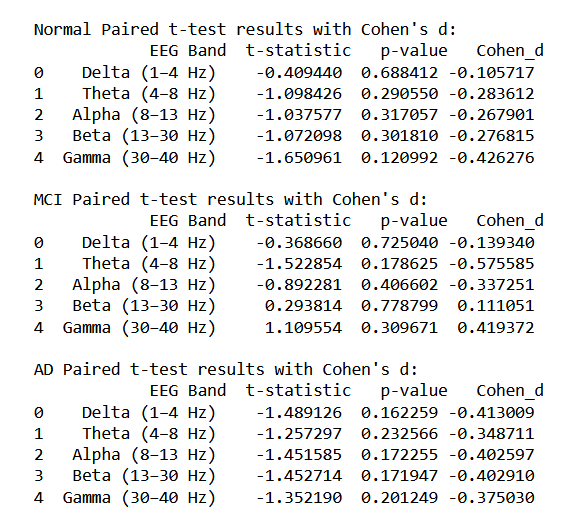
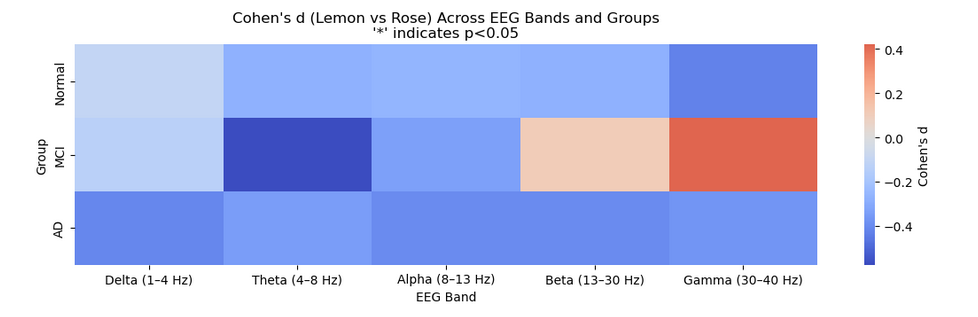
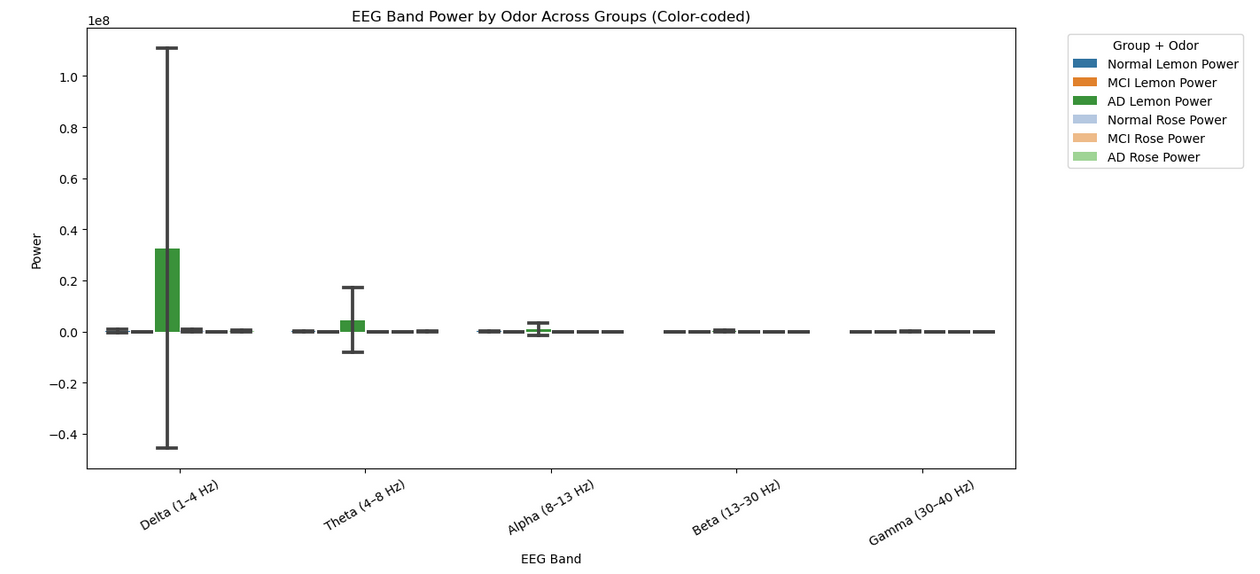
Using pre-epoched EEG data, the pipeline performs signal preprocessing, frequency filtering, and power spectral density (PSD) estimation via Welch’s method. Band power is extracted across canonical EEG frequency bands (Delta, Theta, Alpha, Beta, and Gamma) on a per-trial basis and averaged across channels. Within-group paired statistical tests (paired t-tests with Cohen’s d) are used to evaluate odor-specific effects, while between-group comparisons are conducted using one-way ANOVA to identify disease-related alterations in EEG power.
This work demonstrates an end-to-end EEG analysis workflow that integrates signal processing, statistical modeling, and data visualization to investigate sensory–cognitive interactions. The findings contribute to ongoing research into EEG-based biomarkers for early detection and progression monitoring of neurodegenerative disorders.
View Code